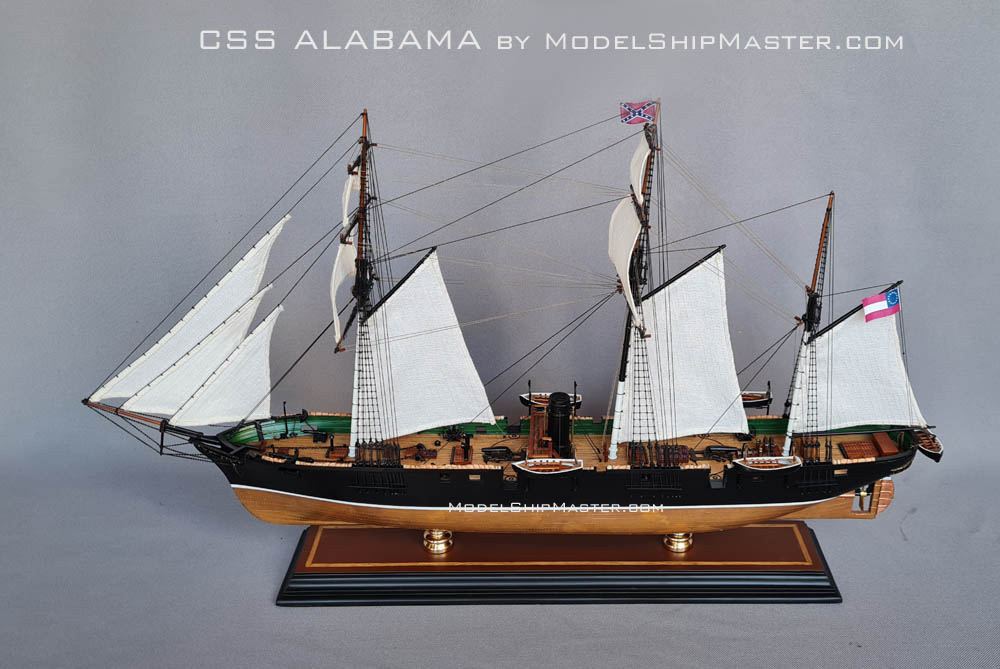
In the history
of commerce warfare, CSS
Alabama
was the most successful raider in terms of numbers of
vessels prized.
The devastation caused by the
CSS Alabama
has frequently been cited as one cause of the decline of
U.S. international shipping in the latter half of the
nineteenth century. An immediate consequence of
their efforts was the 900 percent rise in insurance
rates for U.S.-flag ships, and the resulting transfer of
some 900 ships to foreign registry.
After the outbreak of the American
Civil War in April 1861, the Confederate ports were
blockaded by the Union warships. To break the blockage,
the Confederacy ordered a large and powerful steam ship
(disguised as a merchant ship) designed to attack the
Union merchantmen and also for defense purposes.
In June 1861 Lairds Shipyard in Birkenhead, England
began to build a sleek vessel. When this ship was
launched in July 1862 it attracted the attention of the
American ambassador in England. Enquiries of the British
authorities were fruitless and so the vessel under the
designation Enrica set off on her trial run, never to
return.
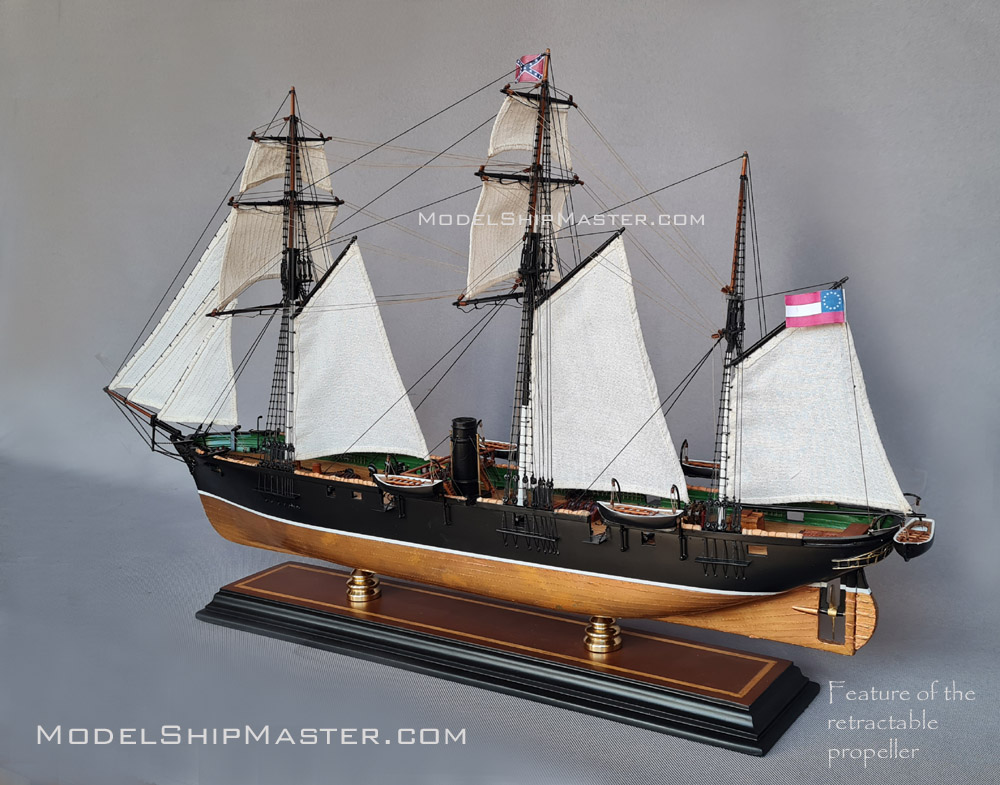
A month later the Enrica anchored in a harbor in the
Azores, was armed and taken over by her new Captain
Raphael Semmes. Flying the Confederate flag, the
warship, now renamed the Alabama, embarked on her
commerce raids.
CSS Alabama spent the next two months capturing and
burning ships in the North Atlantic and intercepting
grain ships bound for Europe. Continuing her path of
destruction through the West Indies, CSS Alabama sank
USS Hatteras along the Texas coast and captured her
crew. After a visit to Cape Town, South Africa, CSS
Alabama sailed for the East Indies where the ship spent
six months cruising, destroying seven more ships before
redoubling the Cape en route to Europe. In total, the
CSS Alabama sunk 62 vessels, mostly merchant ships.
Due to the increasing presence of Union warships, on
11th June 1864, the Alabama sailed into the French port
of Cherbourg. This news reached the commander of the
Union warship USS Kearsarge, Captain Winslow, leading to
the famous sea battle off the French coast on 19th June.
In a 60-minute battle the opponents pursued each other
mercilessly. Due to the superior firing accuracy of the
USS Kearsarge cannon the CSS Alabama was grievously
damaged and finally abandoned.
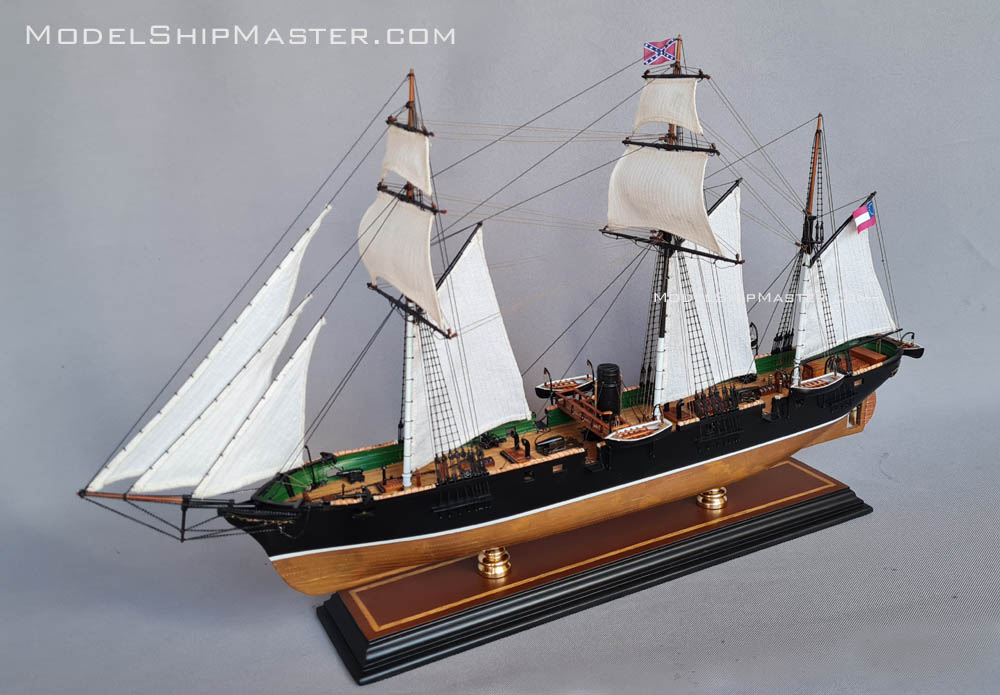
Following the war, the United States
insisted that Britain be held liable for the
destruction wrought by British-built commerce
raiders. These proceedings came to be known as the
Alabama claims, as
CSS
Alabama
alone accounted for as much as $5 million in losses. After several false starts, the claims were finally
resolved under the Treaty of Washington (1871), by
which the United States and Great Britain submitted
to arbitration by an international tribunal composed
of representatives from Britain, the United States,
Italy, Switzerland, and Brazil. The tribunal found
that Britain had not exercised "due diligence" and
awarded the United States $15.5 million in damages.
On November 7, 1984, French
divers from the minesweeper
Circle discovered the remains of the ship lying in
about 195 feet of water six miles off Cherbourg. The
site is now under the protection of a joint French
and American authority.
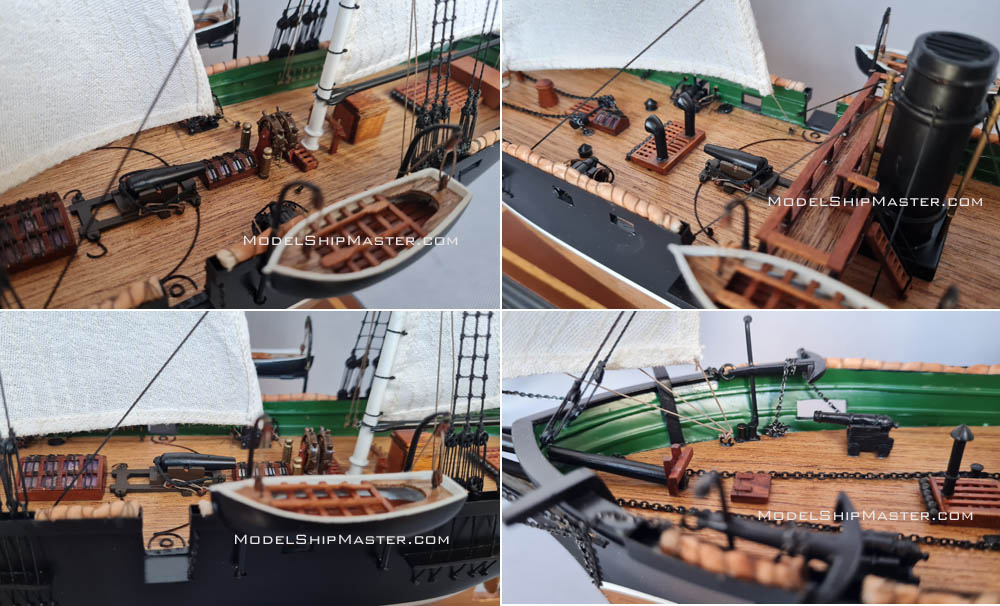
We
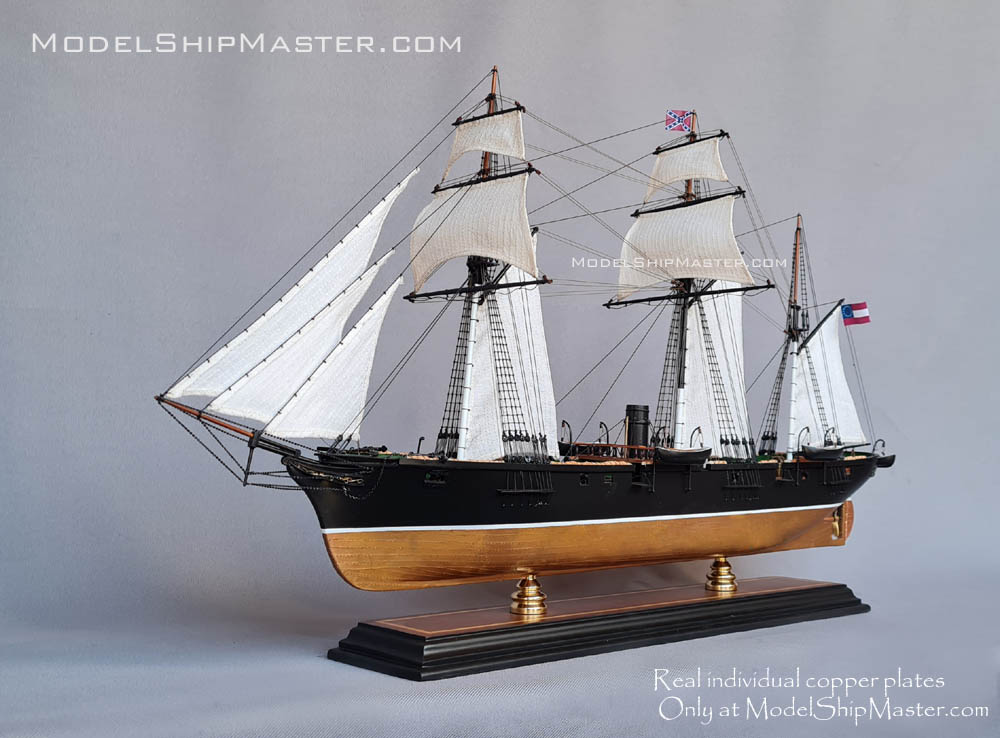
build this primarily wood CSS
Alabama model in two sizes:
27" long x 16" tall x
7"
wide
$2,990
 Shipping and insurance
in the contiguous US included. Other places: $350
flat rate. This model is in stock
and can be shipped within five business days.
Shipping and insurance
in the contiguous US included. Other places: $350
flat rate. This model is in stock
and can be shipped within five business days.
36" long x 24" tall
x 11" wide $3,925
Shipping and insurance
in the contiguous US included. Other places: $450
flat rate.
Made to
order only.
We require only a small deposit to start the
process: $900
The
remaining balance won't be due until the model is
completed, in 9 months.
Other ship, different size? Just let us know by clicking
on this link: Commissioning. The
process will be easy and stress free.
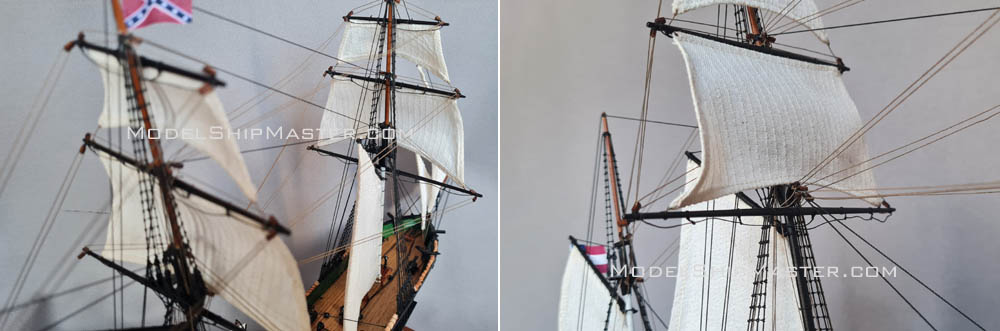
Because you want the best model possible for your proud
ownership, be sure to choose a builder wisely. Ship
models might look very good from afar but when examined
closely, they are different breeds. When you look, pay
particular attention to accuracy. Focus on the large
photos that zoom in details. An authentic model not only
serves your display purposes but also becomes a
valuable heirloom. When
you see a model whose low price is so tempting, do
yourself a favor by looking at its questionable accuracy
and mediocre craftsmanship. THERE ARE BIG
DIFFERENCES BETWEEN AN ART PIECE CRAFTED BY
GIFTED
ARTISANS AND A TOY WHICH IS MASS-PRODUCED BY COMMON
LABORERS.
Be sure to check out our beautiful
here:
USS Kearsage.
"She made it into port unscathed and
fully intact. Y'all did an amazing awesome job with
it. I really love it. It deserves to be on constant
display in my living room where it can be seen by
anyone who enters in. Thank you very much for
keeping me informed and paying attention to detail
so heavily. Hope the best for you. Keep on keeping
on. Sincerely, LB CSS Alabama model owner."
Learn more about the CSS
Alabama here:
https://en.wikipedia.org/wiki/CSS_Alabama