Tall Ships
Sailboats
Pirate Ships
Ancient Vessels
Civil War Vessels
Spanish War
Modern Warships
Submarines
Ocean Liners   
  Cargo Ships
  Immigrant  Ships
Riverboats
Classic  Boats
Hydroplanes
Super Yachts
Other Types
Massive models
Special models
Remote Control
Commissioning
Ultimate models
Small & for Mantels
Paintings
Accessories
Scratch & Dent
Sale&Promotion
  Trade-In
 
 
View Cart
About us
Email Us
Guarantee
Shipping
Site Map

Links

What's in a good model: Information center

Don't see what you want? click here:
Ask


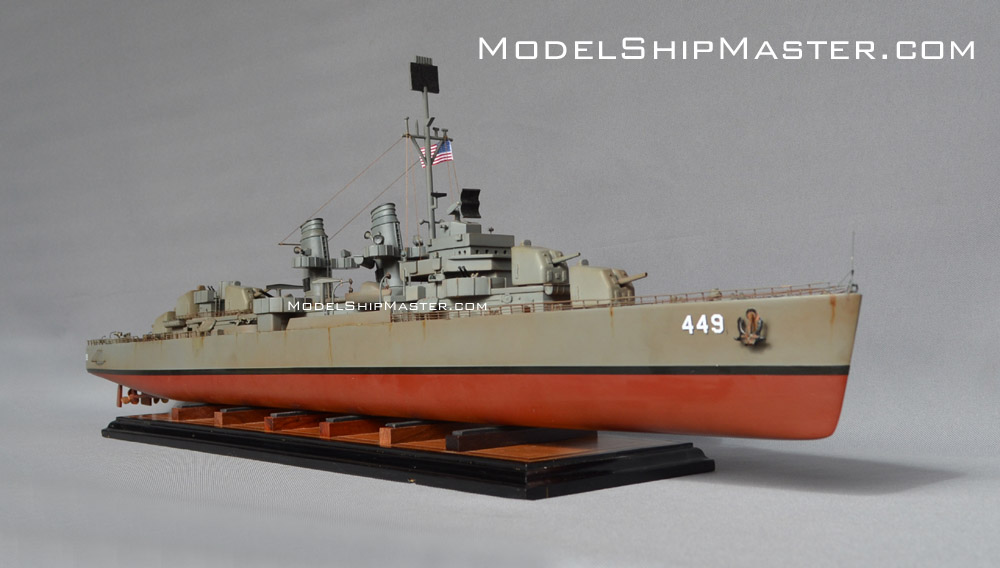
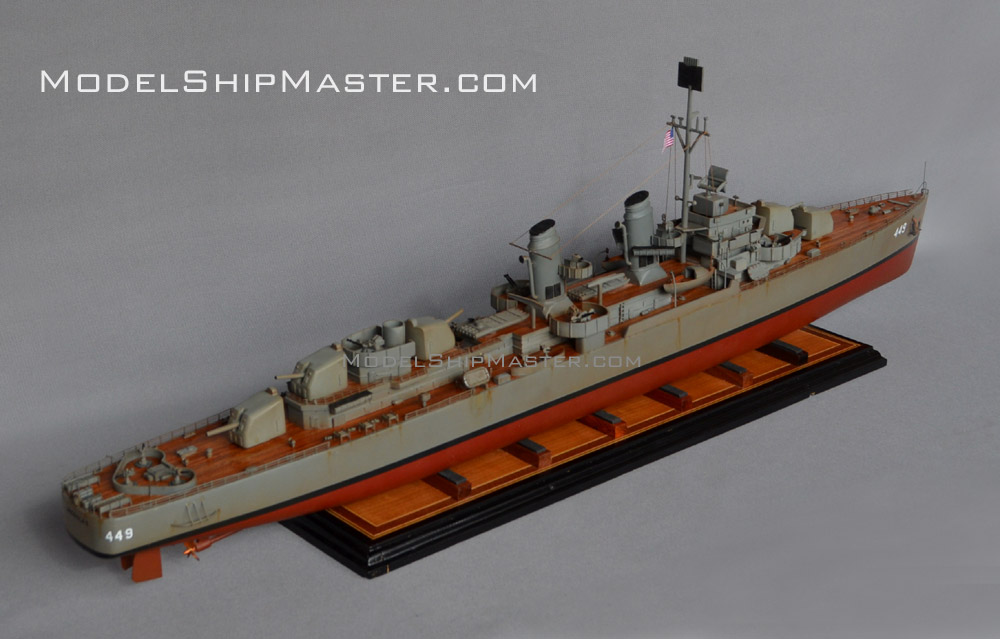
USS Nicholas DD-449

USS Nicholas was the second Navy ship to be named for Major Samuel Nicholas, the first commanding officer of the United States Marines. She was launched on February 19th, 1942, and commissioned June 4th, 1942 and served as flagship of Destroyer Squadron 21 Lieutenant Commander William D. Brown was in command.

On 1 February, as the Japanese began operation "KE"—the evacuation of Guadalcanal, Nicholas covered the 2nd Battalion, 132nd Infantry landing at Verahue and supported them as they began their trek inland to seal off the Cape Esperance area to Japanese reinforcements. En route back to Tulagi Nicholas, with De Haven (DD-469) and 3 LCTs, was attacked by a formation of 14 Aichi D3A "Val" dive bombers. Three bombs hit De Haven and a fourth, a near miss, holed the hull. As her sister destroyer settled in the waters of Ironbottom Sound, Nicholas fought off eight planes, receiving only near misses which killed two of her crew and damaged the steering gear.

On 5 July she participated in another bombardment of Kolombangara. In the early morning hours of the 6th she made contact with enemy surface vessels in Kula Gulf. In the ensuing battle, Helena (CL-50) was lost. Nicholas, while rescuing 291 survivors, took the Japanese ships under torpedo and gunfire. Nicholas and Radford (DD-446) were later awarded Presidential Unit Citations for their persevering performance during the Battle of Kula Gulf."

Back at Tulagi on the 17th, she, with O'Bannon (DD-450), Taylor (DD-468), and Chevalier (DD-451), was sent out to intercept four Rabaul-based Japanese destroyers as they headed for Vella LaVella to cover the establishment of a barge staging area at Horaniu.

Racing up the "Slot", the American destroyers picked up their Japanese counterparts. At 00:56, they swung back toward the Imperial Navy's destroyers, now 5 miles to the northwest. The brief engagement off Horaniu, in which the Japanese "crossed the T" of the American forces but failed to press their advantage, was broken off by the Japanese at 01:03. The American force pursued, scored on Isokaze, and finally dropped behind as engineering problems in Chevalier limiting them to 30 knots. They then turned their attention to the scattering barge group, destroying 2 subchasers, 2 motor torpedo boats and one barge.

On 18 October, the destroyer, now in TG 78.7 escorted reinforcements to Leyte, arriving on the 24th. On 8 November she sailed for Ulithi. En route, her three-ship formation, Taylor and St. Louis (CL-49), was closed by a submarine. Leaving the formation, Nicholas pressed home two depth charge attacks, sinking I-88.

Four days later, Nicholas joined TG 77.1 on continuous patrol of the southern end of Leyte Gulf. There until 6 December she survived 4 attacks by kamikaze suicide-plane formations. On 6 December she assisted in a sweep of the Camotes Sea, bombarded Japanese Naval facilities on Ormoc Bay and then covered Allied landings there. On the 10th she sailed for Manus, returning to Leyte on the 28th for further escort work.

During the first part of February 1945, she escorted vessels between Leyte and Mindoro, whence she proceeded to Manila Bay to shell Corregidor, other islands in Manila Bay, and shore installations at Mariveles. In April. she returned to Luzon to support the Sixth Army as it fought to reoccupy the island and then on the 24th resumed operations in the Netherlands East Indies. From then until 5 May she supported the Tarakan operation after which she steamed north again to Luzon, thence to Leyte where she joined TU 30.12.2 and departed for Okinawa, 15 June. Following strikes on Sakishima, she joined TG 30.8 at Ulithi and screened that group as it refueled and resuppIied the fast aircraft carriers at sea. On 11 August she reported to CTG 38.4, a fast carrier group, and on the 13th screened the flattops during strikes against the Tokyo area.

Approaching Japan in August 1945, Admiral William Halsey, commander of the 3rd Fleet ordered that Nicholas and her sisters O'Bannon and Taylor be present in Tokyo Bay for Japan's surrender "because of their valorous fight up the long road from the South Pacific to the very end." Assigned to his Flagship Task Group, the "Nick" disseminated Japanese pilots and peace emissaries among the fleet, escorted battleship Missouri into Tokyo Bay, and transported Allied and U.S. representatives to the formal surrender on Missouri 2 September.

Decommissioned 12 June 1946, Nicholas remained in the Pacific Reserve Fleet until hostilities in Korea. Reclassified DDE-449, 26 March 1949, she was brought out of reserve to begin conversion in November 1950. In Far Eastern waters until 14 November, she screened the carriers of TF 77 off the west coast of Korea; conducted ASW exercises between Yokosuka and Okinawa; and patrolled the Taiwan Strait. On 3 May 1952 she departed Pearl Harbor again for Korea.

After Korea Nicholas rotated duty in WestPac with 1st Fleet assignments. Her 7th Fleet deployments took her from Japan to Sumatra, while EastPac assignments ranged primarily from Hawaii to the west coast. On occasion 1st Fleet duty sent her to the Central Pacific as in 1954 when she assisted in Operation Castle, an atomic test series.

Nicholas underwent a Fleet Rehabilitation and Modernization (FRAM) between December 1959 and July 1960, emerging from the shipyard in time for her annual rotation to WestPac, which, that year, sent her, for the first time since World War II, to the South China Sea for extensive operations. Reclassified DD-449 on 1 July 1962, she returned to the South China Sea in March 1965. There she became one of the first ships engaged in Operation Market Time—patrol of the jagged South Vietnamese coastline to prohibit smuggling of men, weapons, and supplies into South Vietnam by North Vietnamese junks and sampans.

Relieved of duty 15 April, Nicholas returned to Pearl Harbor only to depart again for Viet Nam in mid-September. Off the embattled coast by 1 October, she carried out surveillance assignments and gunfire support duties until 3 December, when she proceeded to Taiwan for patrol duty in Taiwan Strait. Early in 1966 she returned to Viet Nam for duty on "Yankee Station" in the Gulf of Tonkin, followed by another tour on "Market Time" patrol.

On her return to EastPac in 1968, Nicholas was assigned to support NASA's Apollo Program. From 8 to 23 October and again between 19 and 22 December she operated in the Pacific space capsule recovery areas; first for the Apollo 7 mission, then for Apollo 8. After each of these assignments she returned to Pearl Harbor for training exercises in Hawaiian waters in preparation for a return to the Western Pacific.

On 30 January 1970, having become the navy's oldest active destroyer eight years earlier, the "Nick" was decommissioned in a ceremony at Pearl Harbor (again side-by-side with O'Bannon), stricken from the Navy List, towed to Portland, Oregon, and then broken up in 1972. At the time she was retired, only seven other Fletcher-class ships remained in service with the US Navy.

USS Nicholas earned 16 battle stars including two for submarines sunk.   She was also awarded one of the first Presidential Unit Citations for action in the Solomon Islands in 1943 and a Philippine Republic Presidential Unit Citation Badge. 

"Outstanding among the destroyers of the Pacific Fleet..." said Rear Admiral James L. Kauffman, ComDesPac in 1944, of Nicholas, "...a noble ship".
 

This USS Nicholas  model features:

- Plank-on-frame, hollow hull construction.   (Solid hull is unrealistic and will crack. )
 
- All parts are wood and metal. 

- Light "rust"  appearance that only master modelers can create.

Dimensions: 36" L x 13 T.       $790   S & H is $80

Add a case: www.modelshipmaster.com/products/accessory/displaycase.htm

Wish to purchase it at a lower price?                Tell a friend:    


   © 2008 Global Art Collections -  All rights reserved.
    Earth's largest and finest collections of model ships                                   
14392 Hoover St.   Westminster, California 92683, USA