|
YAMATO
Battleship Model
Battleship Yamato was the
flagship of the Japanese Combined Fleet. She was the biggest battleship ever built,
outweighing the biggest Allied
battleships by more than 20 percent.
Even
at this gigantic size, battleship Yamato could reach
top speed of 28 knots. This extraordinary
performance had much to do with her bulbous bow,
which jutted out 10-feet waves that cancels out other waves
generated by the main part of the ship, greatly
reduced drag at the front. To come up with
this great design, Japanese engineers tested 50
different models.
Yamato's sides
could survive 3,000-pound armor piercing projectiles
like those from the U.S. Iowa's guns. At 23,000 tons, her steel armor weighed more than 30
percent of her total weight. Armor plates
of unprecedented 25 inches (63cm) thick shielded the
turrets of her main guns.
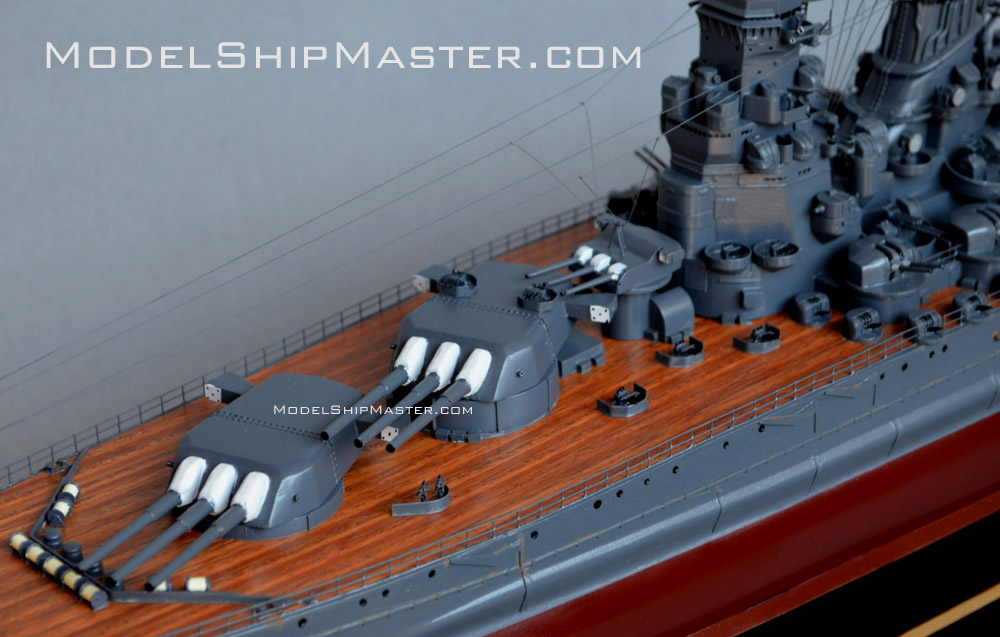
Yamato model's nine main
guns were the largest to ever crown a warship. Each gun
was 69 ft (21 meters) long, weighed 147 metric tons and
was capable of firing high-explosive or armor-piercing
shells. The guns fired shells 18 inches in diameter which weighed about a
Honda Civic car. And these guns could dangerously
strike at an unprecedented range of 25 miles. The nine guns were mounted on three
turrets. Each of these turrets weighed more
than an entire American Fletcher-class destroyer
(3,000 tons versus 2,100 tons.)
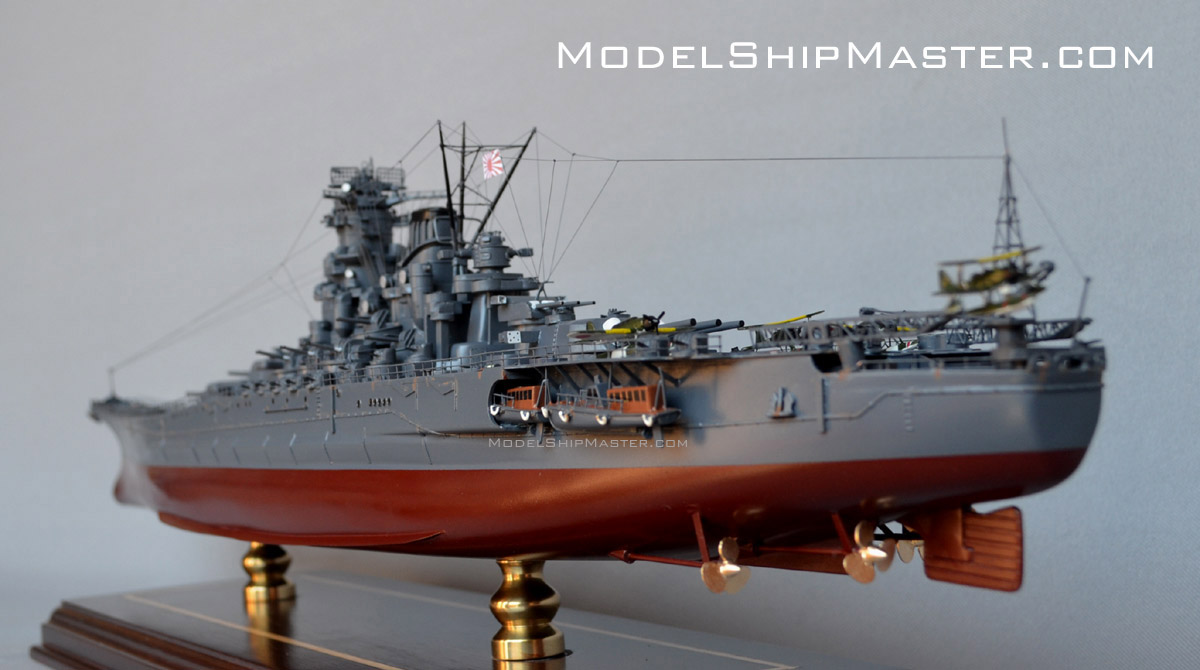
Battleship Yamato
model's secondary guns were also impressive. Her six
inch guns - that is, guns firing shells six inches
in diameter, had a range of 17 miles. And her 24 five inch guns,
mounted in 12 turrets, could destroy targets nine
miles away.
In April
1945, with the US invasion of Okinawa, the Japanese Emperor
demanded action from what was left of the Navy. This led
Vice Chief of the Imperial Japanese Navy General Staff,
and Chief of Staff of the Combined Fleet, Vice Admiral
Seiichi Ito to scrape together all he could to sail
against the Americans.
This meant
the battleship Yamato.
The battle
fleet was simply the 6,000-ton Agano-class light cruiser
Yahagi and 8 destroyers. This was to be a one-way
mission, fighting against a fifteen-hundred-ship
American fleet that outnumbered it by a factor of at
least 6:1. Ito knew it and he personally commanded the
attack.
Dubbed
“Operation Ten-Go” (Heaven One), the fleet started on 7
April directly towards Okinawa. There it was soon
confronted by over 400 carrier-based planes on a fleet
of 11 flattops. The escorts protected Yamato battleship from
submarine attacks, but no airplanes helped her on the
air.
By 1200 the first aircraft appeared over Yamato.
By 1400 the cruiser Yahagi
sank along with half of the destroyers. American pilots concentrated their
torpedoes below Yamato's waterline near her bow and
stern where her armor was thinnest. And the
attacks were on just one side of the hull. By
1420, Yamato's
rudder was shot away, her superstructure ablaze.
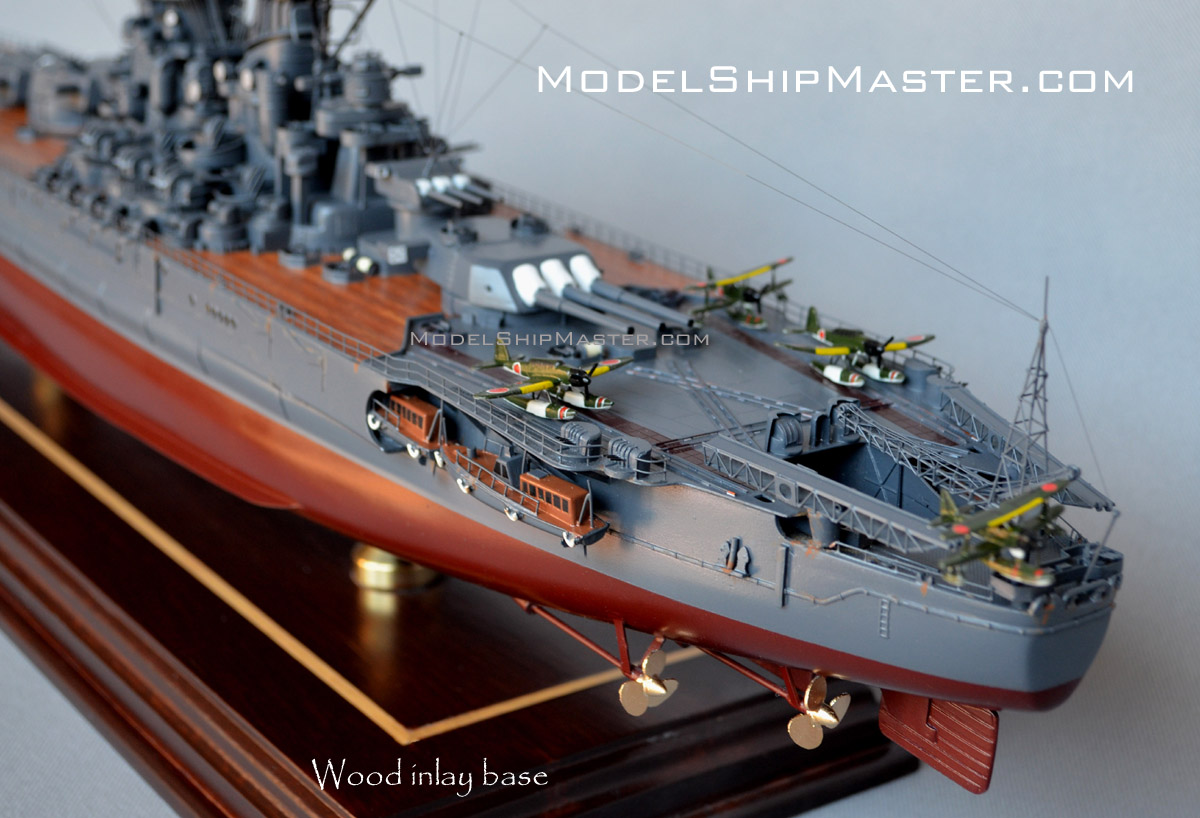
Battleship Yamato put up a
tremendous battle but she was not a match against
nearly four hundred attack planes
all alone. She took 12 bomb and seven torpedo hits
within two hours of battle. Her 1,000 watertight
compartments couldn't save her. At 1423, one of the two bow magazines detonated in
a tremendous explosion. A fire raging in the
battleship's aft secondary magazine caused tons of
ammunition to ignite simultaneously, producing the
blasts that tore the ship in half. These blasts were the
largest ever to occur at sea—over 3 miles high—was seen
180 miles away on Kyushu.
2,747 men,
including Vice-Admiral Seiichi Itō, the fleet
commander— went down with the battleship Yamato. That was
more than the loss by the US Navy in all of the
attack on Pearl Harbor.
The sinking of Yamato ended the era of battleships. Aircraft carriers became king of the seas
afterwards.
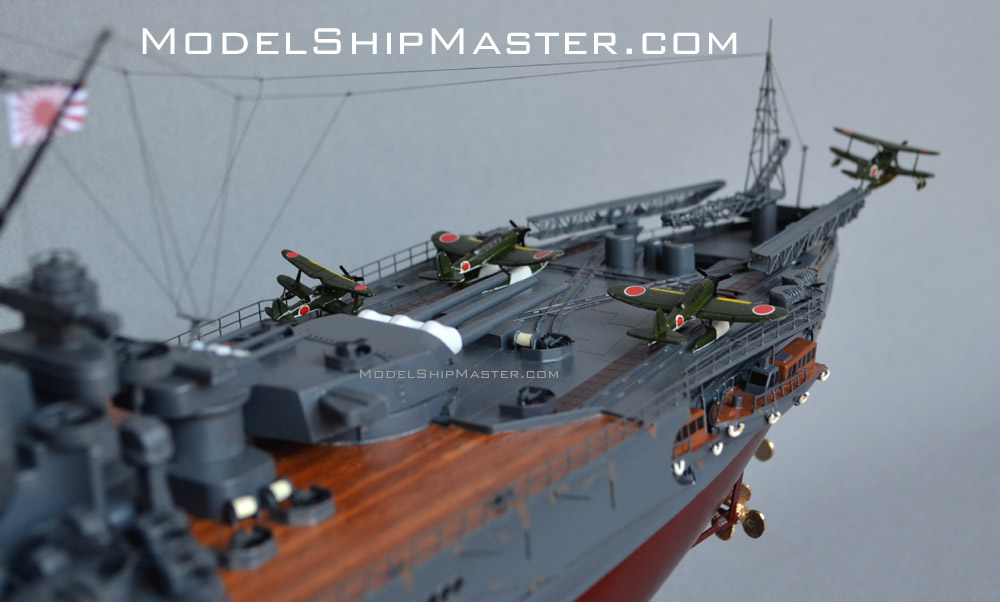
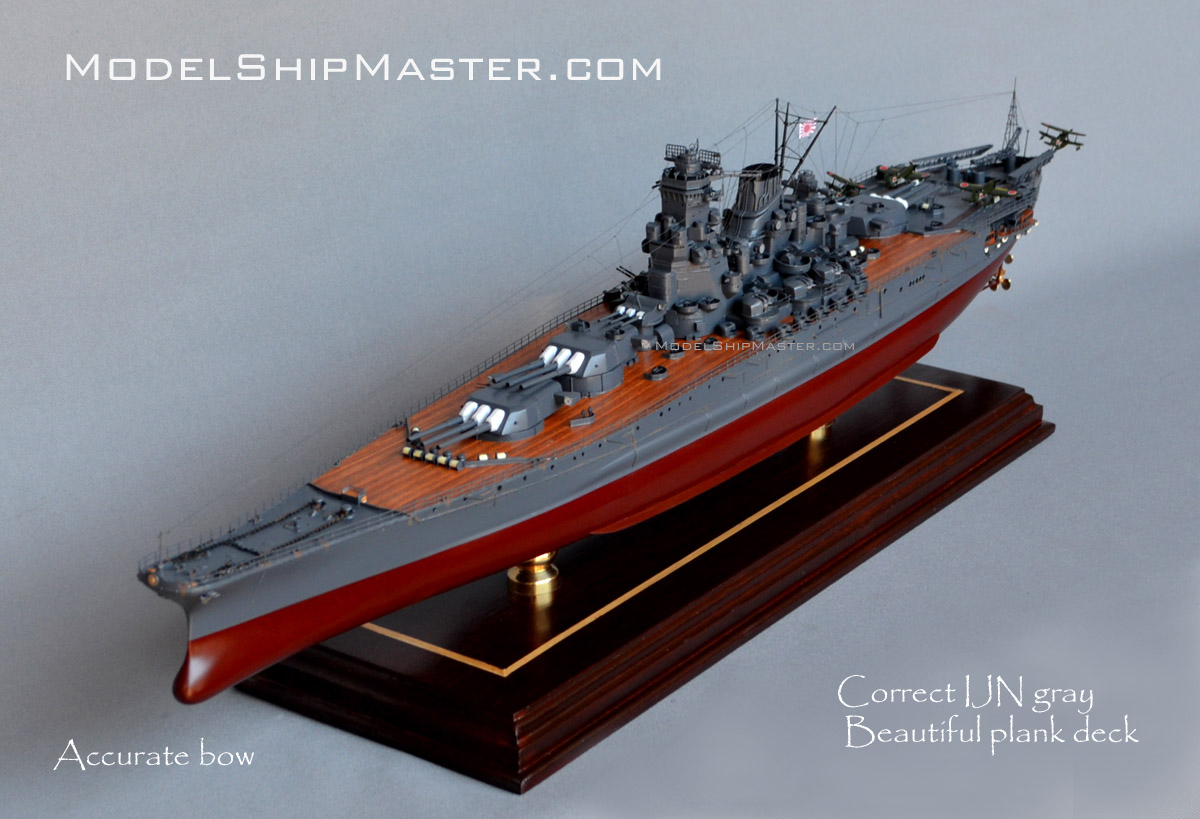
This primarily wood Yamato model
has the following qualities:
- Correct gray color for Imperial Japanese Navy in
WW2.
- Beautiful plank deck,
not bright yellow.
30" long 9" tall
x 6.5" wide
$3,390
 shipping and insurance in the USA is included.
Other countries, $300 flat rate.
This model is in stock and can be shipped within
three business days. shipping and insurance in the USA is included.
Other countries, $300 flat rate.
This model is in stock and can be shipped within
three business days.
53" long x 14
tall x 9 wide $8,540 shipping and insurance in the USA is included.
Other countries, $600 flat rate.
This model is
built per commission only. We require only
a small deposit to start the process.
The
remaining balance won't be due until the model is
completed.
Please
click here for lead
time.
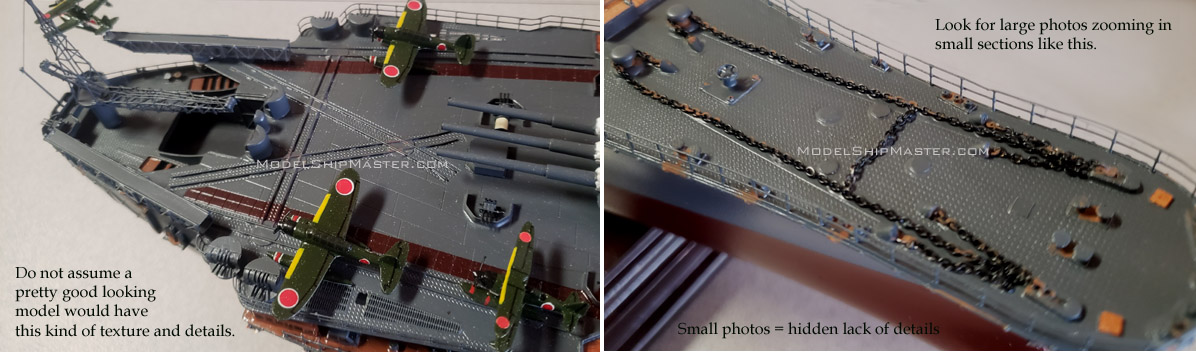
Don't be fooled by wrong Yamato models out there. They have
very wrong hull shape and color (Japanese battleships
color is different than American), bad superstructure, cheap deck,
simplistic guns, erroneous railing, 'interesting' air
plane... Yet one manufacturer claims his product "museum
quality."
Learn more about
battleship Yamato here:
https://en.wikipedia.org/wiki/Japanese_battleship_Yamato
|