
Tall Ships
Sailboats
Pirate Ships
Ancient Vessels
Civil War Vessels
Spanish War
Modern Warships
Submarines
Ocean Liners   
  Cargo Ships
  Immigrant  Ships
Riverboats
Classic  Boats
Hydroplanes
Super Yachts
Other Types
Massive models
Special models
Remote Control
Commissioning
Ultimate models
Small & for Mantels
Paintings
Accessories
Scratch & Dent
Sale&Promotion
  Trade-In
 
 
View Cart
About us
Email Us
Guarantee
Shipping
Site Map

Links

What's in a good model: Information center

Don't see what you want? click here:
Ask


Modern Naval Ship Models


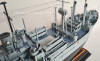
Jeremiah O'Brien
Liberty ship model

31" long

Jeremiah O'Brien is the last unaltered Liberty ship. In 1994, Jeremiah O'Brien gained world attention when she steamed back to the Normandy invasion beaches to participate in ceremonies marking the 50th anniversary of D-Day -- the only US veteran D-Day ship present.
 

Click for more info

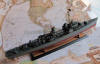
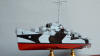
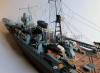
HMCS Haida G-63

47" long


HMCS Haida is the most famous ship in the Royal Canadian Navy, having sunk more enemy surface tonnage than any other Canadian ship. Haida is the only survivor of the 27 Tribal-class destroyers built for the Royal Navy, Royal Canadian Navy, and Royal Australian Navy.  Technologically Haida represented the most advanced naval architecture, marine propulsion systems and naval weapons of her day.
 

Click for more info

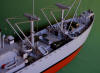
USS Mars AFS-1

37" long


 Mars was the first of a new class that was intended to replace three types of supply ships: the AF, AKS, and AVS. Two innovations were Boeing UH‑46 helicopters and an automatic highline shuttle transfer system to make a rapid transfer of supplies possible. To speed replenishment processing, Mars became the first ship in the Pacific Fleet to be equipped with a 1004 Univac computer system. 
 

Click for more info

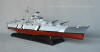
Bismarck
battleship model

57" long


After completion of trials and training programs, battleship Bismarck departed to participate in the battle of the Atlantic. In this battle, Bismarck demonstrated how superbly it had been designed and built. In a mere eight minutes, she sunk the finest and biggest battlecruiser of Royal Navy, HMS Hood.   


Click for more info

Prinz Eugen

heavy cruiser 

 48" long


The design of Prinz Eugen was ahead of its time. The propulsion system consisting of three sets of four boilers and three three-stage geared turbines operated at 450°C and 73 bar steam pressure.  The quality of the artillery and of the fire control systems has never been surpassed. Because artillery has meanwhile been replaced by missiles, this superiority always remain valid. On 24 May 1941, Prinz Eugen fought alongside Bismarck in the Battle of the Denmark Strait against HMS Hood, hitting the British battlecruiser three times and starting a huge fire.  Prinz Eugen also damaged HMS Prince of Wales with four hits.  Constructing now. Sign up for updates: Wish list.


Constructing now

Musashi Battleship

59" long


Musashi, "sister" of battleship Yamato, was commissioned in August 1942 when she proceeded to Truk Lagoon, where Admiral Isoroku Yamamoto made Musashi his flagship. After he was killed on 18 April 1943 (having been shot down by a special U.S. Army Air Forces operation) in the Solomons theater of operations, Musashi returned to Japan carrying his ashes. On 24 October 1944, Musashi was attacked in the Sibuyan Sea by American carrier-based aircraft and capsized to port. She sank at 7:25 PM, taking more than 1000 of her 2399 crew with her. That battle was the only time that the Musashi had fired her guns in anger.


Click for more info

Yamato Battleship

59" long


Yamato was by far the largest battleship ever built, even exceeding in size and gun caliber the U.S. Navy's abortive Montana class. Their nine 460mm (18.1-inch) main battery guns, which fired 1,460kg (3,200 pound) armor piercing shells, were the largest guns ever went to sea.  Each of them had a revolving weight of 2,530t, the weight of a large WW II destroyer.
Expected availability: July 2008.  Sign up for updates: Wish list.
 

MUSASHI ship model
 

USS
Enterprise

CV-65

38" long


Known as "The Big E", the USS Enterprise CV-65 is the world's first nuclear-powered aircraft carrier and, to this day, holds the records as the longest, tallest and fastest carrier.   USS Enterprise's crew of 3,150 consists of 150 officers, 150 chief petty officers, and 2,850 petty officers E-3 and below.


Click for more info

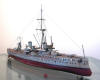
HMS Dreadnought
31" long

Launched in 1905, HMS Dreadnought's revolutionary design made all other battleships obsolete.  So advanced was Dreadnought that her name became a generic term for modern battleships, whilst the ships she made obsolete became known as "pre-dreadnoughts".  
 
HMS Dreadnought
Click for more info

USS Arizona
BB-39

42" long 


Along with USS Missouri, USS Arizona BB-39 is one of the most famous battleships in US Naval history.   USS Arizona was not deployed in England with the Grand Fleet in WW I.  She was too new and burned oil.  England had an oil shortage, but an abundance of coal. Therefore, only coal-burning battleships were deployed with the Royal Navy.  USS Arizona is today still in commission and serves as a memorial to all the US dead from the Imperial Japanese Navy's attack.


Click for more info

USS South Dakota
BB-57
battleship model
34" (1/240)
 

Also known as "Battleship X", the USS South Dakota BB57 was in every major battle and the second most decorated ship of WWII (13 battle stars), behind only the famous USS Enterprise.  USS South Dakota brought down 32 Japanese planes and was the first ship to fire on the Japanese home islands.  

Click for more info

USS Indiana
BB-58
battleship model

34" long


With her nine 16” guns, USS Indiana BB-58 was a formidable weapon.  Her powerful engines could drive her to 27 knots. USS Indiana was commissioned in April 1942 and participated in the assaults on the Marshall and Gilbert Islands.  She participated in the carrier raids on the Carolinas and the Japanese Home Islands.  BB-58  was also in the battles in the Marianas, Saipan, Philippine Sea, Palaus, Iwo Jima, and Ryukus
 

Click for more info

USS Massachusetts
BB-59
battleship model

34"long
 (1/240)


On November 8, 1942, USS Massachusetts BB-59 engaged the French battleship Jean Bart in a gun duel and fired the first American 16" projectile of World War II. By the end of the day she had fired more than 700 16" projectiles, crippled the Jean Bart and sinking Fougueux and Boulonnais.  Over the course of the war, she sank or damaged 5 enemy ships and shot down 39 aircraft. USS Massachusetts BB-59 earned 11 battle stars for her World War II service and never lost a man in combat.


Click for more info

USS Alabama
BB-60
battleship model

34" long
34" (1/240)


USS Alabama BB-60 shot down 22 Japanese planes.  Her radar was the first to detect enemy bombers in the Battle of the Philippine Sea, at the unprecedented range of 190 miles. This warning enabled U.S. fighters and anti-aircraft gunners to destroy over 400 Japanese planes.  USS Alabama BB-60 earned 9 battle stars providing gunfire support for amphibious assaults on Japanese-held islands and protecting carrier task forces.
 

Click for more info

USS
Iowa
BB-61
battleship model
48" long

USS Iowa BB-61 earned nine battle stars for World War II service and two for Korean War service.  Currently, USS Iowa is the only ship of her class not open to the public as a museum.      

Click for more info

USS New Jersey
BB-62
battleship model

48" long (1/240 scale)

USS New Jersey BB-62 received nine battle stars for World War II; four for the Korean conflict; two for Vietnam; and three Campaign Stars for service off Beirut, Lebanon and service in the Persian Gulf, prior to Operation Desert Storm. With a total of 19 Battle and Campaign Stars, USS New Jersey BB-62 is America's most decorated battleship and surviving warship.
   

USS
Missouri
BB-63
battleship model

48" long (1/240 scale)
 

USS Missouri BB-63 is  notable as the final battleship to be built by the United States, the second-to-last in the world after HMS Vanguard, and the site of the Japanese surrender at the end of World War II.  USS Missouri BB-63 received a total of eleven battle stars, and is presently a museum ship at Pearl Harbor.  The powerful warship has nicknames as "Mighty Mo" or "Big Mo".   
 

Click for more info

USS
Wisconsin
BB-64
battleship model
48" long

USS Wisconsin BB-64 is the second ship of the United States Navy named in honor of the U.S. state of Wisconsin.  USS Wisconsin BB-64currently functions as a museum ship at Nauticus, The National Maritime in Norfolk, Virginia.
 

Click for more info

USS Texas
BB-35
battleship model
 20" long (1/350)


The Battleship USS Texas BB-35 is the last and oldest Battleship afloat that served in both WWI and WWII. She was considered the most powerful warship afloat because of her ten 14"/45 guns in five twin turrets. 


Click for more info


USS North Carolina
BB-55


USS Washington
BB-56


North Carolina
BB-55 and her sister ship Washington were the first Post-Washington Treaty battleships as well as the first of the fast battleships.   Before this class, the United States Navy favored staying power and fire power over speed. The North Carolina class had a speed of 27 knots versus the 21 knots of the pre-treaty Colorado Class.  The class was completely different from all previous US battleships, and set the pattern for all subsequent vessels.  The integration of the first computer at sea, the Mark I fire control computer allowed the ship to maintain a constant fire control solution even when steaming at full speed and performing drastic evasive turns. 
Expected availability: undecided.  Sign up for updates: Wish list.


USS Kidd
DDG-993
destroyer model

40" long
(1:175)


The KIDD DDG-993 was the world's largest destroyer and, after the Aegis-equipped Arleigh Burke class, the most powerful multi-purpose destroyer in the fleet.  She is the most formidable warship of her size ever to patrol the world's oceans, blending the best features of the SPRUANCE Class destroyers with the combat system of the VIRGINIA Class nuclear cruisers. KIDD DDG-993 is a triple-threat, able to operate offensively, to deal with simultaneous air, surface, and sub-surface attacks.


sold out

USS Callaghan DDG-994
destroyer
40" long
(1:175)


USS CALLAGHAN
DDG-994 was the second ship  in the Navy named after Rear Admiral Daniel Judson Callaghan who was killed in action on November 13, 1942, while leading a force of US ships against a far superior Japanese force during the Battle of Guadalcanal.


sold out

USS
Bunker Hill
CG-52
destroyer

41"  long (1:175)


The first ship to employ the Vertical Launch System (VLS), USS Bunker Hill CG-52 was given the nickname "Vertical Swordsman". In November 1990, she sailed in support of Operation DESERT SHIELD and DESERT STORM and served as the multinational Anti-Air Warfare Commander, directing the tactical employment of 26 ships and over 300 combat aircraft.  USS Bunker Hill CG-52 was one of the first ships to launch TOMAHAWK Land Attack Missiles against Iraqi forces.


sold out

USS Mobile Bay
CG-53
destroyer model

41" long
(1:175)


USS Mobile Bay CG-53 was deployed in August 1990 in support of Operation Desert Shield and Storm, becoming the first Aegis cruiser to circumnavigate the globe. In the Arabian Gulf, the ship distinguished itself by becoming the first Battle Force Anti-Air Warfare Commander to control a four-carrier Task Force. Mobile Bay CG-53 launched 22 Tomahawk land-attack cruise missile strikes, and controlling carrier-launched attack aircraft that contributed to the complete destruction of the Iraqi Navy.


sold out

USS Cimarron AO-177
40" L
(1/200 scale)

As the number of Navy-manned fleet oilers had diminished, the Navy "jumboized" all five ships of the fleet. The AO Jumbo program is designed to increase the 120,000 barrel fuel capacity of these ships to 150,000 barrels and add the capability of carrying 600 tons of cargo ammunition.  USS Cimarron AO-177 was the lead ship of those five ships.
 

Click for more info

USS Liscome Bay
CVE-56
aircraft carrier model

32"  (1/350)
 

Burial at Sea for two victims of the submarine attack on the "Liscome Bay"at 0533, Liscome Bay listed to starboard and sank, carrying Admiral Mullinix, Captain Wiltsie, 53 other officers, and 591 enlisted men—including Cook Third Class Dorie Miller, famous for his actions during the attack on Pearl Harbor—down with her; 272 of her crew were rescued. American casualties of the assault on Makin exceeded the strength of the entire Japanese garrison of that island.
 

Click for more info

USS Gambier Bay
CVE-73
aircraft carrier model

32"  (1/350)
 

On the morning of October 25, 1944, USS Gambier Bay
CVE-73 was steaming off the island of Samar. With 4 battleships, 8 cruisers, and 11 destroyers, Vice Admiral Takeo Kurita's Japanese Centre Force steadily followed and at 0658 opened fire.  USS Gambier Bay launched the aircraft of Composite Squadron VC-10 from within the safety of a driving rain squall.  Unable to top 18 knots, she was easy game for the much faster Japanese warships.  By 0820 she was within range of accurate 8-inch heavy cruiser gunfire, was hit repeatedly and was soon dead in the water.  She capsized and sank at 0907 as the only U.S. carrier sunk by gunfire in WW 2.
 

Click for more info

USS Saipan

CHA-2

25"  (1/350)
 

No other vessels in the world is comparable to the USS Saipan
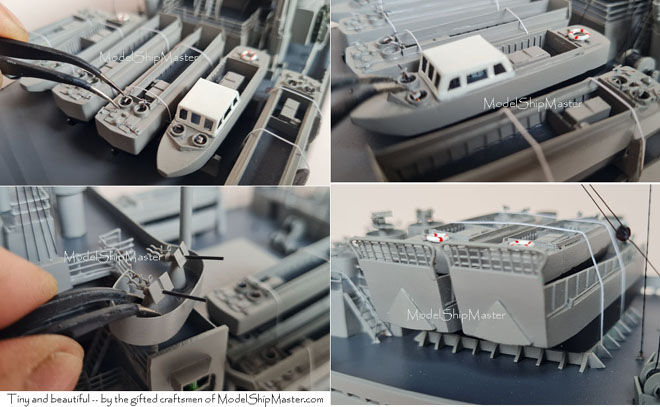
CHA-2. A US first class amphibious assault ship, she has 30 Marine Corp helicopters are stationed on the flight deck, ready for action.  Her giant stern gale provided access to a mobile harbor basin where 30 landing crafts, laden with soldiers, tanks, jeeps, ammunition, lie in readiness for whatever action needed. 
 

Click for more info

Swift Boat
26.5" long 
(1:24)


The U.S. Navy Swift Patrol Boats were invaluable in chasing enemy infiltrators through shallow rivers and along the coastline of Vietnam during the war.  One of the commanders was U.S. Senator John Kerry.  He commanded the PCF-94 in early 1969.
 

Click for more info

PBR MarkII
24" long 
(1:16)
 

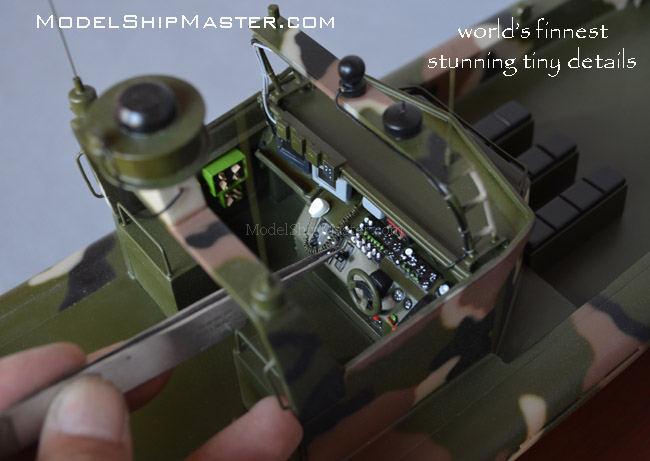
Patrol Boat, Rigid (sometimes River or Riverine), or PBR, is the US Navy designation for a type of rigid-hulled patrol boat used in the Vietnam War from March 1966 until the end of 1970.
 

Click for more info

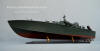
PT-109
32" long  (1:30)


Kennedy's boat PT-109 was rammed by the Japanese destroyer Amagiri on August 2, 1943, cutting it in half and killing two of his men. Kennedy led the survivors, clinging to the wreckage of the boat, to safety on the deserted Plum Pudding Island. The wreckage of PT-109 was located.  However, under current Navy policy, the wreckage is a gravesite and may not be disturbed.


Click for more info

USS Crockett
PG-88

52" long
(1:72)

The U.S.S. Crockett PG-88 was the smallest and pound-for-pound the deadliest man-of -war in the U.S. Navy.   She could reach a top speed of 50 knots but more impressive still was the fact that she could accelerate her 230 tons from 0 to 40 knots in 60 seconds.

Click for more info

USS Defiance
PG-95

32" long 
(1:200)


The turbine-powered high-speed patrol boats that went into service with the US Navy at the end of the sixties took shipbuilding into the age of technology. These fast and maneuverable vessels represented a breakthrough into powerful new design. The slender aluminum hull cuts through the water with prodigious power, the optional auxiliary gas-turbine engine alone develops 13,300 shp.


Click for more info

USS Nicholas destroyer
DD-449

36" long
(1/125 scale)


USS Nicholas DD-449 served as flagship of Destroyer Squadron 21 and earned 16 battle stars including two for submarines sunk. Awarded one of the first Presidential Unit Citations for action in the Solomon Islands in 1943.  Also received a Philippine Republic Presidential Unit Citation Badge.  Admiral Halsey ordered that USS Nicholas DD-449 and twin sister O’Bannon be present in Tokyo Bay for Japan’s surrender “because of their valorous fight up the long road from the South Pacific."


Click for more info

USS Bell
Destroyer
DD-587
36" long
(1/125 scale)


During the late evening of 31 January 1945 while in 13°20' N., 119°20' E., she joined O'Bannon (DD 450) and Ulvert M. Moore (DE-442) in sinking the Japanese submarine RO-115.

Bell received twelve battle stars for her participation in World War II. SOLD


Click for more info
 

Gloire


The first ironclad warship


The launch of Gloire in 1859 was a milestone in warship development.  Prior to that time, fighting ships had been made of wood.  The French Gloire was the first of the new breed.  While her hull was made of wood, her sides were fortified with a belt of iron armor plate almost 5 inches thick.  This metal armor directly responded to the threat posed to all-wood ships by new weaponry, including explosive shells instead of solid cannon balls.   Gloire's armor, together with her steam power plant and screw propeller, made her the most advanced man-of-war in the world at that time.  Sign up for updates: Wish listor have it faster: commission it.


USS
Pennsylvania

The fist landing


The date was January 18, 1911, and the place was San Francisco BayEugene Ely successfully landed his Curtiss D-IV "Puhser" biplane on the deck of the Pennsylvania.  After 45 minutes, he took off from the ship and landed ashore 2 miles away.  This momentous event demonstrated that ships could serve as floating airfields.  It marked the beginning of naval aviation.  Sign up for updates: Wish listor have it faster: commission it.


USS
Missouri
BB-11
 (1/350)


Sign up for updates: Wish listor have it faster: commission it.


USS
Connecticut
BB-18
 (1/350)


Sign up for updates: Wish listor have it faster: commission it.


USS
South Carolina

BB-26
 (1/350)


The South Carolina class of battleships was the first battleships designed to carry one large size as their main battery of weapons. All previous ships had mix caliber weapons. The arrangement of their gun turrets were also revolutionary, with one turret firing over another at each end of the superstructure was more efficient than the previous mixed caliber pre-dreadnoughts.  This turret design has become a standard for the all of the world’s future battleships.
Sign
up for updates: Wish listor have it faster: commission it.
 

uss south carolina

USS Nevada
BB-36

 (1/350)


The only battleship to get underway during the Pearl Harbor attack. Add to your Wish list
 

uss nevada

USS Oklahoma
BB-37

 (1/350)


Oklahoma was at Pearl Harbor when the Japanese attacked on 7 December 1941. Moored outboard of USS Maryland (BB-46), she was hit by a great number of Japanese Type 91 aerial torpedoes. With her port side torn open over much of its length, Oklahoma rapidly rolled over and sank to the harbor bottom. Add to your Wish list


USS New Mexico
BB-40

 (1/350)

When the Japanese attacked Pearl Harbor on 7 December 1941, New Mexico was in the Atlantic anchored in Casco Bay, Maine. Within the month she was soon transferred to the Pacific. On 1 August 1942 she left the west coast for Pearl Harbor and between 6 December through 22 March 1943 she escorted troop transports and operated in the southwest Pacific. She then returned to Pearl Harbor to prepare for the Aleutian Islands, Alaska, operation. On 17 May she arrived at Adak and she started bombarding Kiska on 21 July. Sign up for updates: Wish listor have it faster: commission it.
 
uss new mexico

USS Mississippi
BB-41

 (1/350)


Sign up for updates: Wish listor have it faster: commission it.
 
uss mississippi

USS Idaho
BB-42

 (1/350)


Sign up for updates: Wish listor have it faster: commission it.
 
uss idaho

USS California
BB-44


43" (1/175)


The fifth California was launched in 1919 and commissioned 1921. For 20 years, California served first as flagship of the Pacific Fleet, then as flagship of the Battle Fleet.  From 17 October to 20 November she played a key role in the Leyte operation, including the destruction of the Japanese fleet in the Battle of Surigao Strait. On 1 January 1945 she departed the Palaus for the Luzon landings. Her powerful batteries were an important factor in the success of these dangerous operations driven home into the heart of enemy-held territory under heavy air attack.  In August, she covered the landing of the 6th Army occupation force at Wakanoura Wan, Honshu. She remained supporting the occupation until 15 October. Sign up for updates: Wish listor have it faster: commission it.
 
uss california

USS Helena

CL-50
 

42" (1/175)


The Helena was launched on 27 August 1939.  By chance she was in the berth normally assigned to Pennsylvania at Pearl Harbor when the Japanese attacked; and this became a prime attack target.  Within 3 minutes of the time the first bomb of the attack fell on Ford Island, a lone torpedo plane launched a torpedo and hit Helena on the starboard side almost amidships.  Prompt action brought the forward diesel generator up within 2 minutes, making power available to all mounts which immediately sent up a heavy fire that kept her free from further damage. Outstanding damage control kept Helena afloat.  Many times later she gave the Japanese occasion to regret their failure to sink her that 1st day of the war.
 Helena was the first ship to receive the Navy Unit Commendation. Her actions in the Battles of Cape Esperance Guadalcanal, and Kula Gulf were named in the citation. Helena also earned the Asiatic-Pacific Area Campaign medal with seven stars. Sign up for updates: Wish listor have it faster: commission it.
 

USS HELENA